
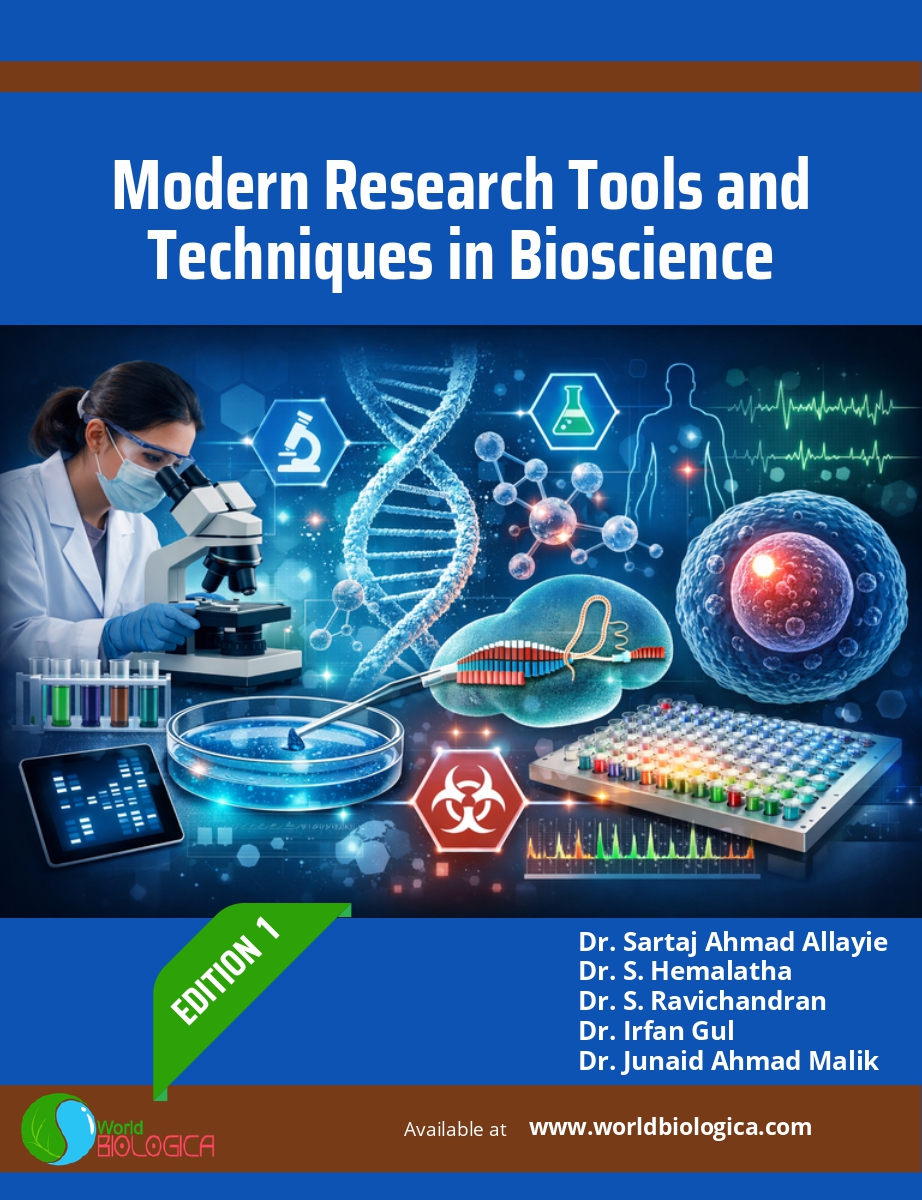
Modern Research Tools and Techniques in Bioscience
Dr. Sartaj Ahmad Allayie, Dr. S. Hemalatha, Dr. S. Ravichandran, Dr. Irfan Gul, Dr. Junaid Ahmad Malik
ISBN: 978-81-958714-9-0
Publisher/Imprint: World BIOLOGICA (India & USA)
Pages: 85
Format: e-Book
Language: English
Edition/Volume: 1st
© Year: 2026
Publication date: February 2026
Price
₹ 1250
About the Book
This book has its origins in a course that we began developing at the respective universities in the mid- 2009s to teach Genotoxicity and Molecular Biology to Zoology students in a way that would interest them and show the connections of fundamental Genotoxicity and Molecular Biology and Nanotechnology to modern Biology. From our own research experiences and interests in Genotoxicity and Molecular Biology, we know that almost all areas of modern life sciences integrally involve Genotoxicity and Molecular Biology, Biochemistry etc. in both experimental techniques and in basic understanding of process or function. However, we and many colleagues with whom we have spoken have been unhappy over the years with published attempts to direct a practical manual to this audience.
As we set out to write this book, we had certain definite goals in mind. We wanted to write a practical manual that was truly directed at life science students, one that integrated modern Biology, Genotoxicity, Biochemistry, Nanotechnolgy and Molecular Biology techniques into the presentation of the material.
Keeping all this in view, the present manual has been written to help the readers of Zoology in conducting their research work, separate chapters have been incorporated in this book. Since all techniques described in this book are routinely used in the laboratory, it is useful even for beginners in this field.
Table of Contents
Preface
Chapter 1. Laboratory safety rules and tips
- Biology Lab Safety Rules
- Some laboratory tips
- Preparation of buffers and solutions
Chapter 2. Oxidative Stress Biomarkers
- Introduction
- Lipid Peroxidation
- Antioxidant enzyme activity assays
Chapter 3. Genotoxicity studies
- Introduction
- Chromosomal aberration test (CAT)
- Sister chromatid exchange assay
- Micronuclei assay
- Comet Assay
- Isolation of DNA
- RNA Extraction
- DNA Sequencing
Chapter 4. Proteins, carbohydrates and lipids
- Introduction
- Determination of protein amount in blood serum by biuret method
- Chromatography of amino acids
- Separation of proteins by gel-filtration
- Protein Electrophoresis (SDS-PAGE)
- Carbohydrate
- Isolation of glycogen from muscles and the liver
- Determination of lactic acid in muscles
- Determination of glucose concentration in blood serum by orto-toluidine method
- Lipids
- Determination of ketone bodies in blood serum
- Determination of cholesterol amount in blood serum
Chapter 5. Identification of bacteria by biochemical reactions
- Gram staining
- Oxidase test
- Catalase test
- Secondary tests
- Indole test
- Methyl red test
- Voges proskauer (vp) test
- Citrate utilization test
- Decarboxylase/deaminase/dihydrolase assays
Chapter 6. Immunological techniques in life science
- Introduction
- Preparation of IgG
- Double Immunodiffusion (The Ouchterlony Technique)
- Hemagglutination assay
- Enzyme Linked Immunosorbant Assay (ELISA)
- Electroimmunoassay (Rocket Immunoelectrophoresis)
- Immunoelectrophoresis
- Counter current immunoelectrophoresis
- Western blotting or Immunoblotting
Chapter 7. Nanotechnology in life science
- Synthesis of nanoparticles
- Synthesis of gold nanoparticles (McFarland et al., 2004)
- Synthesis of Silver Nanoparticles (Solomon et al., 2007)
- Synthesis of zinc oxide nanoparticles
References
About the Authors
Dr. Sartaj Ahmad Allayie
Dr. Sartaj Ahmad Allayie (M.Sc., B.Ed., M.Phil., Ph.D.) is a dedicated academician and a versatile research scientist with a multi-disciplinary focus spanning Zoology, Cancer Pharmacology, Endocrinology, Animal Physiology and Environmental Toxicology.
His research journey is distinguished by a deep exploration of nature’s pharmacopoeia. He earned his Ph.D. from Annamalai University for his investigative work on the “Photochemical Composition, Bioactivity and Anticancer Potential of Leaf Extracts of Naringi Crenulata,” establishing a strong foundation in natural product discovery. This complements his earlier M.Phil. research on the endocrine physiology of crustaceans, showcasing his breadth from molecular biology to whole-organism systems.
Dr. Allayie has successfully channelled this robust research expertise into the undergraduate classroom. With over ten years of teaching experience across various government degree colleges in Jammu and Kashmir, including his present position at Government Degree College, Shopian, he is adept at translating complex scientific principles into engaging lessons for college-level students. His pedagogical success is reflected in having guided hundreds of students with a remarkable pass rate.
A prolific contributor to scientific literature, he has authored more than 30 publications, including research papers, authoritative books such as “Apiculture” and “Tools and Techniques in Bioscience,” and book chapters for international publishers like Springer/Nature, Elsevier. His scholarly work bridges fields, examining topics from the anti-angiogenic effects of plant extracts to the ecological impact of environmental pollutants.
Actively engaged in the broader academic community, Dr. Allayie serves as the Responsible Editor for the International Journal of Current Research in Applied Biology (IJCRAB) and contributes as a peer reviewer, helping to shape contemporary scientific discourse.
Dr. Sartaj Ahmad Allayie’s career embodies a synergistic blend of field and lab-based inquiry, scholarly writing, and committed teaching. His work is driven by a passion for uncovering biological mechanisms and applying that knowledge to foster learning and innovation.
Contact: drsartajzol@gmail.com
Dr. S. Hemalatha
Dr. S. Hemalatha is a distinguished academic researcher, currently retired as Professor from the Department of Zoology at Annamalai University, Chidambaram, Tamil Nadu. With a career dedicated to advancing Zoological science and mentoring future generations, she has established herself as a leading figure in her field. Her research expertise is in toxicology, Ecotoxicology, and the environmental impact of pollutants and pesticides, with a specific focus on aquatic organisms, evidenced by significant publications. As an active participant in the scientific community, Dr. Hemalatha has regularly presented her findings at numerous conferences and symposia, both nationally and internationally. A cornerstone of her professional achievement is her exceptional record in research leadership and project acquisition.
As a dedicated mentor and supervisor, Dr. Hemalatha’s guidance has been instrumental in shaping academic careers. Under her expert supervision, more than 20 research scholars have successfully completed their Doctoral Degree (Ph.D.) in Zoology and Bioinformatics. Furthermore, she has guided a substantial number of M. Phil and M.Sc. students through their research endeavours, fostering a rich legacy of scholarly excellence. Dr. Hemalatha’s work is characterized by a rigorous scientific approach, a commitment to environmental health, and a profound dedication to education. In this publication, she brings together decades of research experience, pedagogical insight, and supervisory acumen to offer a comprehensive and authoritative perspective on her area of specialization.
Contact: hemalatha058@gmail.com
Dr. S. Ravichandran
Dr. S. Ravichandran is a distinguished faculty member at the Centre of Advanced Study in Marine Biology, Annamalai University, India. He holds a Ph.D. from Annamalai University and completed his postdoctoral research at the National Institute of Oceanography in Goa.
His primary research expertise lies in the Taxonomy and Ecology of marine crustaceans. A prolific contributor to his field, Dr. Ravichandran has authored over 220 publications in leading international journals and has been credited with the discovery of 13 new crustacean species. He is also a dedicated mentor, having supervised 26 M.Phil. scholars, 16 Ph.D. candidates, and 3 postdoctoral fellows.
In recognition of his scientific contributions, he has been honoured with the Visiting Scientist Award from the Royal Swedish Academy of Sciences and the National University of Singapore, as well as awards and fellowships from the Indian National Science Academy (INSA) and the Indian Academy of Sciences (IAS).
Contact: sravicas@gmail.com
Dr. Irfan Gul
Dr. Irfan Gul is a dedicated educator, researcher, and entomologist with over a decade of experience in the academic world. His professional journey is rooted in a profound fascination with the intricate world of insects, a passion he expertly translates into both his teaching and scholarly work.
He completed his Master of Science in Zoology from the University of Kashmir, laying a strong foundation in biological sciences. Driven by a curiosity for systematic classification and the unique fauna of his region, he pursued his doctoral studies at Punjabi University, Patiala. His PhD research focused on the meticulous taxonomic studies of select ant taxa (Hymenoptera: Formicidae) restricted to the High Altitude regions of the North-West Himalaya, contributing valuable insights into the biodiversity of this ecologically sensitive zone.
With more than ten years of teaching experience, Dr. Gul has taught students at various colleges across the Kashmir Division. He is currently imparting knowledge in the Department of Zoology at Government Degree College, Shopian, where he continues to shape young academic minds. His teaching portfolio includes a range of specialized subjects such as Entomology, Ethology, Apiculture, Sericulture, and Applied Zoology, blending theoretical knowledge with practical applications to foster a new generation of biologists and environmental stewards.
His commitment to advancing scientific knowledge is evidenced by his research contributions. Dr. Gul has authored nine published research papers, primarily in the fields of entomology and taxonomy, further solidifying his expertise and active engagement with the scientific community.
Contact: irfangul777888666@gmail.com
Dr. Junaid Ahmad Malik
Dr. Junaid Ahmad Malik obtained his Bachelor of Science degree in 2008 from the University of Kashmir, Srinagar (Jammu & Kashmir). He completed his Master of Science in Zoology in 2010 and was awarded a Doctorate (PhD) in Zoology in 2015. He later earned a Bachelor of Education (B.Ed.) degree in 2017 from the University of Kashmir, Srinagar.
He began his professional career as a Lecturer in the School Education Department, Government of Jammu & Kashmir, where he served for two years. Currently, Dr. Malik is working as an Assistant Professor (Academic Arrangement) in the Department of Zoology at Government Degree College, Kulgam, Kashmir (Jammu & Kashmir). He is actively engaged in undergraduate teaching, mentoring, and research, with over 12 years of research experience in the biological sciences.
Dr. Malik’s research interests encompass ecology, soil macrofauna, wildlife biology, conservation biology, and related interdisciplinary areas. He is the Founder and Chief Executive Officer of World BIOLOGICA, India, an academic publishing and research-oriented organization dedicated to promoting quality scientific research publication.
He has published more than 20 research papers in reputed national and international peer-reviewed journals. His scholarly contributions also include authorship of 5 books, 46 book chapters, editorial responsibility for 30 edited volumes, and more than ten popular editorial and academic articles. Dr. Malik currently serves as the Editor-in-Chief of Inventum Biologicum: An International Journal of Biological Research and the International Journal of Innovative Scientific Research (IJISR).
Dr. Malik has actively participated in numerous State, National, and International conferences, seminars, workshops, and symposia, with more than 20 conference papers to his credit. He is a life member of the Society for Bioinformatics and Biological Sciences (SBBS), Membership ID: LMJ-243.
Contact: malik.junaidahmad@gmail.com